Showing posts with label private painting class Denver. Show all posts

Tuesday, June 9, 2015

The Best Art Event of the Summer!

"Love, Peace, Owls" 18 x 24 mixed media on canvas
Happy June everyone! It’s finally here....June 13 & June 14 is Denver’s big annual Summer Art Market (SAM).

I'm happy (and proud) to say it's my 14th year as a SAM artist! While it's hard work (almost daily prep since April) it's still my favorite weekend of the year!

I know summer is a busy time for everyone but please be sure to stop by if you’re in town and say hi—SAM is free and a great family outing as well with music, food and kid’s activities.  Here’s the detailed info:

What: Summer Art Market—over 250 fine artists!
Where: 2nd and Grant (near Speer and Broadway in Denver)
When:  June 13 and June 14 (Saturday  10A to 6P and Sunday 10A to 5P)
Where to find me: Booth 146 (on 2nd just west of Grant)

I may be a little biased but I really do think variety and quality of original fine artwork is amazing from traditional oils to contemporary sculpture! And there are price points for everyone!
"Copper Canter" 18 x 24 mixed media on canvas

"Growing Strong" (detail) Mixed Media/Collage 20 x 30

Getting ready for SAM---paintings and more paintings!
Speaking of pricing better get back to framing, tagging, etc. (you can see my living room staging area above) with just days to go. Here are a few of the nature inspired acrylic mixed media paintings I’ve been working on.  Have a great summer week everyone--hope to see you this weekend!

P.S. Want to paint this summer? There are still some openings in my next group class (Painting Nature and Florals) which starts on Wednesday, June 24. Please visit my website for more info. 

Tuesday, September 9, 2014

Challenge Day 9: Me and My Shadows

"Vines on Vine St." 8x10 oil on linen
 
Shadows play an integral role in letting sunlight permeate the scene. They provide a 'setting' that compliments the sun-kissed lights. Often, shadows will have a golden tint, or even a rosy red color that conveys a unique atmospheric glow. (Watercolorist Jeanne Dobie)

That was a close one. Thankfully (and just in time) a giant box of linen canvas panels just landed on my porch from Jerry's--so no running out of panels before the end of the daily challenge! (Yes I do have several art stores close by but unfortunately none of them carry small linen panels like these.)

Now back to painting. There are a couple of color strategies going on in this little pumpkin oil study. One is overall color unity.  There are many ways to achieve color unity (limited palette, mother color, etc.) but one “short cut” method is toned support.

I simply give the canvas (or paper) a quick color “wash” before blocking in my drawing/shapes. In fact, I’ve used this approach for so long it’s almost strange for me to paint on a pure white canvas.

Today, I took my overall color cue from a sunny autumn late afternoon in my neighborhood and used a warm yellow-orange wash. The second goal was have a warmer color dominance (including the shadow patterns) with only a few cool notes. Thanks again for joining me during daily challenge month—I appreciate all your visits and kind comments! 

Tuesday, July 22, 2014

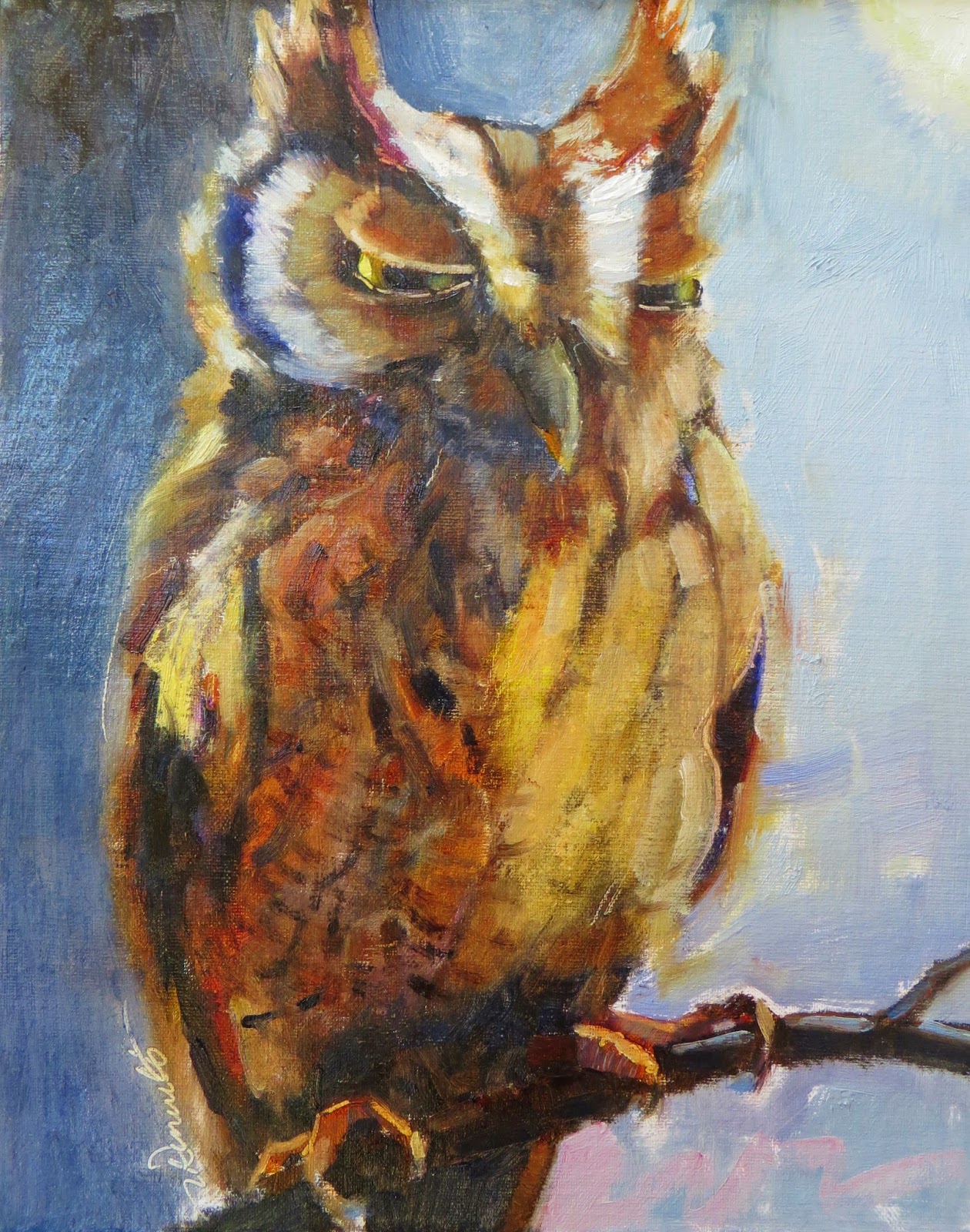
It's Owl Good in the Summer

"It's Owl Good" screech owl oil painting study 8x10 on linen
SOLD--Thank you!!

Summer is flying by (no pun intended)! I’ve been enjoying the outdoors and having a great time working on art projects with my summer students. I’ve also had some challenges and frustrations working on my of key art goals for this year: Improve plein air painting skills.

Ahh...Unfortunately as much as I love nature I’m just not “outdoorsy.” It’s one of those skills that I know will come in time with patience and practice.  As I think about where to practice again in a nice shady quiet spot I decided to put in some air conditioned studio time. But in 2 weeks am off to another one day plein air workshop.(Am just hoping not to get lost in the wilderness this time...)

On a much happier note I always enjoy participating in the Daily Paintworks challenges—especially when the theme relates to birds or flowers.  There’s something really motivating about painting something that you have a strong connection with.

So you can imagine my delight when I saw this week’s challenge was—hoot, hoot—owls! If you visit my studio you’ll find a cherished international owl collection thanks to my friends, family, and students. Yep, I’m a proud “bubophile.” (That’s a fancy word for owl lover.)

So I set aside a few other art projects to quickly paint this this adorable (and sleepy) little screech owl I fell in love with at a raptor education event.  Isn’t it cool how their mottled feathers mimic tree bark?

I often paint really large colorful owls but I really enjoyed painting this little guy. Thanks again to artist Linda McCoy for posting my dream challenge this week! Finally if you're an owl fan like I am, you'll find 100 owls to inspire you on my Pinterest board. P.S. Did you know a group of owls is called a Parliament? 

Sunday, August 26, 2012

When Opposites Attract

"Botanic Beauty" 6x6 oil on panel

An artist finds his happiest combination in a play of complementary colors. They are direct contrasts yet do not jar; they awaken the beholder, but do not disturb him. Charles Burchfield

Last week’s painting challenge on DPW was an exciting complementary color (direct opposites on the color wheel) challenge posted by fellow DPW painter Layne Cook.

I choose the violet/yellow pair in this alla prima (wet in wet) oil study of an iris because I wanted to explore the full range of warm to cool violets—one of my favorite color ranges. Yellows not so much—but here sunny yellows (some pure notes along with neutral ones) are the perfect warm companion for the cool violets. 

As Burchfield notes above, complements are one of the easiest way to have a successful and exciting color strategy for your art. Here are some quick tips for working with your complementary color pairs:

Work with your color pairs in ranges than one “out of the tube" solid color. This gives you many more options. So violet range and yellow range, red range and green range, and blue range and orange range (or as I remind students in our hometown: Go Broncos!).


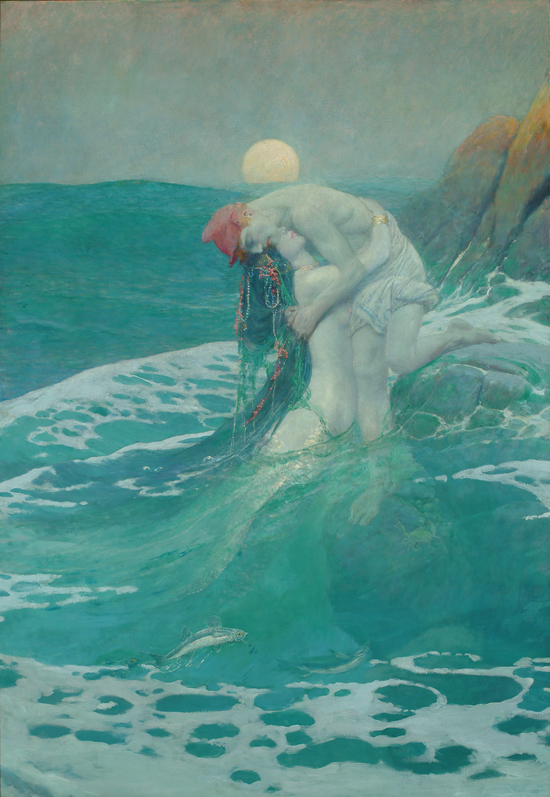
Your painting will likely work better if one of the color pair should dominates the other. So mostly blue range with some orange range for example. Here’s one of my favorite green blue dominant paintings (note the touch of red oranges) "The Mermaid" by American illustrator Howard Pyle. 

When you paint two complements side by side they really attract the eye. You can take advantage of this color power couple where you want to the viewer to focus.  On the flip side when you need to calm a color down, the complement can be a more interesting alternative for creating neutrals rather than a pre-mixed gray, black, umber, etc. Trouble with your highlights? Try a touch of complementary color in your white mixture. (So whitish green highlight on bright red tomato for example.)

For more discussion about exploring and balancing opposites in your painting check out one of my favorite oil painting books: The Yin Yang of Painting by Zhang.  Finally, a big thanks again to all my recent DPW buyers and my ongoing students for your support this summer!

Tuesday, August 14, 2012

Good Things Come in Small Paintings

"Pink in the Park" 6x6 oil study
Sold-thank you!
Creativity is allowing yourself to make mistakes. 
Art is knowing which ones to keep. 
Scott Adams

There's so much to paint in the summer it's almost overwhelming. Painting smaller studies (like these 6x6 squares) remind me why “almost daily” painting can be so rewarding. Finding the time to paint every single day might just not be realistic in your world right now. But if you want to grow your artistic vision and skills, I think it’s extremely helpful to paint MORE than you are now.  Whatever that may be for you. 

I promise you’ll find this extra time at the easel beneficial in the long run. Here are three key reasons I think “almost daily” painting is a great goal for any artist who wants to improve:
"Redbud Rester" 6x6 oil study

I love the creative process but the reality is you’re not always going to have a stellar painting day.  In fact, you may have a disappointing painting day when you least expect it.

This can really catch you off guard.  But when this happens to me I have some sense of comfort and hope that a more successful painting may be just be around the corner--rather than weeks or months away.

Also, many artists at one time or another are challenged either by time or budget or both. Small-ish (under 8x10 let's say) paintings are not typically a significant time or monetary investment.  This doesn’t mean you have to use cheap materials for daily painting. On the contrary I prefer linen panels (Raymar), professional paints, decent brushes, etc.  I feel like I can "splurge" because I'm not using so many supplies at once. Plus, if you paint a "keeper" you'll be happy you used nicer materials.

With regard to time, it may take a few tries, but I find I can paint a 6x6 in under 120 minutes give or take. Check out Craig Nelson's excellent book: 60 minutes to Better Painting for more ideas regarding quick studies.

If you enjoy painting on a larger scale, smaller studies are also a wonderful way to “brainstorm” and have fun with paint. For example, in my light and shadow rose study today I tried some some "looser" dragged edges which I thought worked pretty well. Thanks DPW for featuring my little rose on the DPW Facebook page!

In the sparrow study, I tried a strong orange toned canvas to help give a sense of the warm August sunshine. Some of the orange bits work and some I'm not as crazy about. Still worth the test. 

I often compare painting to puzzle solving.  Painting more often allows to test a variety of solutions before you commit to a bigger canvas. For example, you could try different color strategies, take a new color for a test run, change your value key, experiment with your brushwork etc.  It’s also fun to do quick small abstracts and then scale them up--particularly small squares because they scale so easily. Happy summer painting everyone!

Sunday, July 24, 2011

Summer Temptations

Happy Very Warm Summer Everyone! Thanks for your patience as summer has lured me out of the studio for the past week or so. While I've been teaching (thanks again summer students for all your hard work), I've also been distracted to several summer activities that have (unfortunately) not involved painting. But I promise to be back to the easel soon.

One of my favorite places to find a colorful inspiration are farmer's markets. Here are a few photos from the South Pearl Street Farmer's Market here in Denver, Colorado. One of my favorite things to buy are the amazing High Desert Peppers (hot of course!) and the Front Range Basil Tomatoes from the MMLocal booth. I love the colors of the rainbow beets as well.


For those of you who have been patiently following my Still Life 101 tips, here's Step 3 or How to Get Your Sketch onto the Canvas after you've toned your canvas. I feel there two basic rough in options, one is a bit more "devil may care" while the other your left brain will love.

Option 1:  Assuming I warmed up with a planning sketch (as described in previous post) I "just do it." I lightly sketch my subject (from careful observation) directly onto the canvas. Focus on the big shapes again using a dry brush. (I usually use a round or small filbert.) Just enough paint to see the lines on a toned canvas. I prefer a brush rather than pencil or charcoal which I find smudgy. 

This next part is very important because I think the key to success for moving from your simple big shapes to painting is creating believable 3D objects. On the Compose it Grid tool I was using big, simple flat shapes—more of an outline to get started. But when I switch to the canvas I’m now adding dimension to the shapes. For example the onion that was a rough circle becomes a sphere, the stems become slender cylinders, the table top a giant cube, etc. 

Tone on tone sketch in using Option 2 (lines not visible in photo)
Option 2: Left brain spoiler alert! Sometimes, it's helpful to ensure that your overall shapes and proportions are relatively accurate. Otherwise you’ll find you need to correct later while painting. This means lots of scraping, etc. which in turn breaks your rhythm. So I’d rather move objects now rather than later.

Therefore a more careful way to transfer your composition what is often called the grid transfer method. This classic method can get quite complicated (I’ve seen some artists use hundreds of transfer squares) depending on your subject, size of canvas, and level of detail. But especially for smaller paintings (under 12x16 or so), I find I only need a simple “4 box” grid. I create this by marking the half way point on each side of the canvas.

For example, for my onions on a 9x12 vertical canvas I marked 4.5 inches (top and bottom) and 6 inches on the sides. With a very light pencil line I then draw a connecting line to create 4 quadrants (in this case 4 rectangles). Next, make a corresponding grid over your planning sketch or reference photo with pen or pencil. If you have a color printer photo you may want to print out a low res black/white version to grid. Or if you used a tool like a Compose It Grid obviously the space is already divided for you.

Another benefit from locating these “north/south” and “east/west” dividing lines is you can improve your composition greatly by avoiding the placement of any strong lines or shapes directly on them. Hopefully one of those 2 methods will work for you and help get you going. If we can make that an almost ritual like habit daily painting becomes that much easier.

P.S Quick thanks to Cindy and the nice folks at Compose It Grid for the blog link on their Reviews Page. I promise I have no affiliation with them--I just really, really love these easy to use grids.